

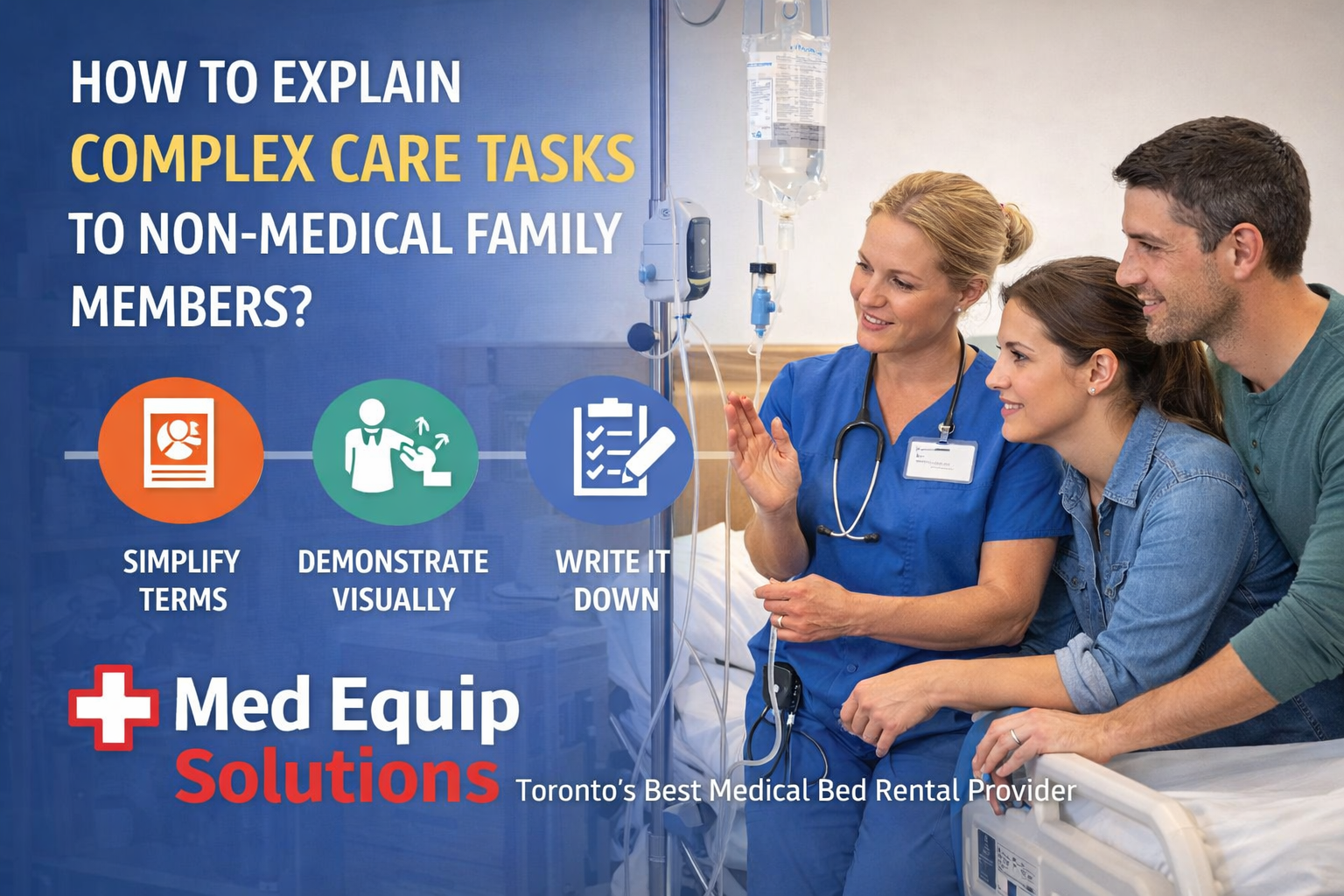
Having a loved one discharged from the hospital can feel daunting. This is a challenge we face every day in Toronto at MedEquip Solutions. You may be finding yourself in a role you never anticipated needing to play. Suddenly you are a nurse, a technician, and a coordinator.
Trying to explain these really complex tasks to family members is a very delicate touch. You have to balance the technical aspects with the emotional reality of it. It’s a framework for teaching professional care skills to anyone.
Simplifying the Language of Care
Healthcare jargon frequently builds a barrier between the caregiver and the work at hand. Replace complex terms with plain English for every instruction. For example, don’t say “pressure ulcer mitigation.” Instead, tell them that repositioning is important to maintaining healthy skin.
Using Visual Aids and Demonstrations
Real-time performance of a task is the best way for people to learn. Demonstrate how the bed controls work to family members before letting them attempt it. Each delivery at MedEquip Solutions includes hands-on product demonstrations. Visual cues, such as coloured tape on buttons, also help prevent errors.
Encouraging a “Teach-Back” Method
The “teach-back” method makes sure the family truly grasps the specific steps for care. Please ask the family member to explain the process back to you. Meanwhile, watch them do it for the first time. This is its model for detecting gaps in knowledge before an emergency strikes.
- Use simple analogies to explain how things work mechanically.
- Keep long processes down to three simple steps.
- Print out a “cheat sheet” with pictures you can refer to quickly.
- To ease anxiety in the learning stage, invite questions.
- Always keep the “why” in mind for every specific care action you take.
- Manage the Logistics of Home Medical Equipment
Quality equipment is essential for safe and efficient home care. You have to show how these tools simplify the caregiver’s life. MedEquip Solutions is here to make the process easier for families from all across Toronto.
The financial world of equipment The financial information of the equipment
Most families prioritize budgeting during a health crisis. You may need to explain the hospital bed rental cost to other relatives. Openness about what things will cost enables everyone to better prepare for the weeks or months ahead. Monthly rentals usually offer a more convenient route for short-term recovery requirements.
When deciding whether to rent a hospital bed or buy one, keep the long term in mind. Rental is often best for a rehab stay of three months or less. Conversely, buying could save money if the patient needs permanent care at home.
Choosing the Right Sleeping Surface
A conventional mattress is usually unsuitable for a patient with limited mobility. So families choose to rent a hospital bed with a mattress. Such surfaces are specialized to redistribute weight across the body. In turn, they can assist in preventing painful and dangerous skin breakdowns.
- Pressure-redistributing mattresses assist in managing skin moisture levels.
- Hospital-grade covers make for speedy and instant sanitization.
- The integrated side rails give the patient a feeling of security.
- Caregivers’ lower backs are protected by electric height adjustment.
- Modern frames usually come with batteries for power outages.
- Special Considerations for High-Need Patients
Not every patient falls into a standard category of medical equipment. You should be prepared to explain more specialized tools to the family.
Handling Bariatric Care at Home
You should never exceed the weight capacity of standard beds to maintain safety standards. If your patient needs more space, a discussion about renting a bariatric hospital bed is in order. These beds come with reinforced steel frames and heavy-duty motors. When it comes to bariatric gear, you have to frame the need in a way that is dignified for the patient.
Teaching Proper Body Mechanics
Inadequate lifting followed by a physical injury can be the first step in caregiver burnout. Use the height of the bed to your advantage. Before doing any patient care, always make the bed waist high. Also, remind them to suck their core in tight and use their legs.
- If you feel uncertain, never lift a patient without assistance.
- Reduce friction during patient repositioning with slide sheets.
- During a transfer, keep the patient near your body.
- Be sure the wheels are locked before the patient is allowed to move.
- Feet to be used for a flat, wide base.
- Organizing the Daily Care Routine
Delivering professional-level care in the home is all about consistency. A disorganized schedule means missed meds and additional stress for all involved.
Creating a Shared Digital Calendar
Bring the whole family together using technology. With a shared calendar, everyone can find out when the next nurse visit happens. It keeps tabs on who is on which shifts throughout the day as well. Having a clear schedule, with no doubt in the primary caregiver’s mind about where they need to be and when, reduces everyone’s mental load.
Managing Ongoing Rental Logistics
A patient recovering from an illness may find their equipment needs change as they recover. As the situation develops, you need to check how hospital bed rental vs. purchase compares over time. MedEquip Solutions provides varying terms to align with these shifts as needed. Place all rental documents in a single folder so they are available when needed.
Reassess this equipment when patient weight increases or decreases significantly. You may need to exchange for a standard model or rent a bariatric hospital bed. Our proactive approach ensuresthe safest possible environment for our patient at all times.
- Put a daily “to-do” list up in a very visible spot.
- Additionally, a pill organizer can help prevent medication dosing errors.
- Use that phone to set alarms for every two hours, the turn interval.
- It often helps to keep a record of food and fluids the patient has taken for the doctor.
- You are asked to note any shifts in the patient’s mood or behaviour.
Communicating with Compassion
Keep in mind that family members are also grieving the loss of “normal.” What matters more is that your explanations empathize as well as being technically accurate.
Validating the Caregiver’s Feelings
Recognize that it can be tiring and emotional to learn these tasks. Let the family know they are OK to be frustrated or tired. But remind them that just being there is the most important aspect of healing. Positive reinforcement can help their confidence as they learn new care skills.
Providing Resources for Further Education
No one can know everything after a day or one conversation. Share MedEquip Solutions videos or brochures with the family. Dry and Clean, Affordable Hospital Bed with Mattress Rental Learning about the various options available to us has allowed us to regain some sense of control over this situation.
Conclusion
It is an admirable challenge to teach non-medical family members how to perform complex care tasks. MedEquip Solutions is proud to serve as Toronto’s best medical bed rental company. Our perspective is that the right equipment, such as a rental hospital bed with a mattress, enables caregivers.
Clearly explaining the rental cost of a hospital bed and safety protocols reduces family stress. Anyhow, do focus on simple language, hands-on practice, and regular assistance for your team. As a team, you can offer professional care without losing the warmth of home.


